Ok, so you have done everything you can in regards to your book/short story/memoir etc, and now the obvious next step is to publish...right?
Well dear friend, in case you haven't already noticed, becoming a traditionally published author is not as easy as it once was. Especially for amateurs. Turns out, the vast majority of publishers won't even consider reading your query (I'll get to that in a minute) much less a sample of your story unless you have an agent to represent you.
All this, I had heard before, since I've been cruising the internet, searching for publishing advice for a while now. Every blog, every article and every author testimony will tell you, "Hire an agent! Hire an agent! And oh, did I mention...HIRE AN AGENT!" Yeah, yeah--I get it. However, what these nincompoops seem resolved on NOT explaining, is exactly how one hires an agent. And after doing some extensive research over the past few days, I feel as though I may have observed enough to help out the writers who are as clueless as I once was.
Keeping in mind that I know next to nothing, and I tell you this assuming you know nothing, or next next to nothing. Get it? Got it? Good.
Step One: Research agents. Sounds simple enough. But before taking on this task there is something you should realize...to be a "literary agent", is not a real profession. Meaning, anyone can label themselves as an agent if they so choose. Therefore it is important to look into each agent's credentials. So whip out our best friend Google and start doing back ground checks on those bad boys. I HIGHLY recommend using various websites to help narrow down your search such as AgentTracker (just google it), or other handbooks like Publisher'sWeekly, LitearyMarketplace. Or 2013 Agent's Guide. If you desire, you can significantly narrow down your search by looking for local agents exclusively. Once again, GOOGLE IT. That's our new motto. When in doubt, inquire of the great Google!
Step Two: Write down every seemingly plausible representative for your book. Why? Because you're going to be sending out lots of queries. Why? Because you're going to get rejected sweet cheeks...sorry to bust your bubble.
Step Three: Go back and research those agents again, disregarding any who are not representing your genre, are not accepting queries right now, or any who look just plain shady and unreliable.
Step Four: Write a query letter, taking into account what each of those agents requests of you. I will write a new post soon talking about the query letter process.
Hopefully these tips have cleared away some of the confusion for you. Now, all you have to do is begin! I'm currently perfecting my query letter, and will update you on the process soon. If you have any tips regarding the obtaining of an agent, please share them in the comments below!
Written by: Karoline Kingley


MY First Lines
16 June 2013
The first line of any book is the most important. If you are a writer, I'm sure this advice has been hammered into your head. Maybe you've had a good experience, and have yet to the know the tedious experience of re-writing a single sentence 100 + times until you are happy with it. That is the thing about writing. It will rarely (if ever) be perfect. You can only strive toward happy contentment in your own work.
There are obvious reasons why the opening line of a story is the most important. You want to make a good impression. Why would the audience continue reading the next chapter or even the next paragraph if you fail to hook them at first glance? And if you haven't already noticed, first lines are the most legendary. Few people will quote the 30th line from the 19th chapter in A Tale of Two Cities, but everyone remembers, "It was the best of times it was the worst times," etc...
But I'm here to tell you something contrary to popular belief. Sometimes, the first line does not have to sum up the entire story. I can tell you are already skeptical. But I caused myself a great deal of grief and writer's ache because I couldn't live up to that tried and true rule. Just to make things clear, it is, most of the time a good idea and even wonderful idea to write a first line that gives you one broad yet swift glance of the entire story, and then leave you hungering to know more. But not always.
Every now again, perhaps due to setting or style it is indeed acceptable to the throw the reader straight into an action scene. If the main idea is to hook the reader, can that not be just as adequately accomplished with a gripping glimpse into the dilemma at hand? You may have noticed this in my book Royal. I introduced the story by saying, "Jolenta's eyelids fluttered open at the sound of a faint creak." Is Jolenta the main character? No. Is the faint creaking a deeply metaphorical occurence? Not in the slightest. However, what is actually taking place, is very important, and is designed to make you interested to find out what will happen next.
But I also have experience with the opposite end of the spectrum. In my latest project for a romantic comedy the opening line is, "It has been nearly a decade since the last eligible bachelor worth mentioning came to Summerton." From that quick glimpse, you can probably tell where the story is going, which is exactly my intention.
The point is, it's okay to break the rules every now again. You don't have to send your readers off an emotional cliff with your first sentence. It's okay if I don't know what's going on, just as long as you make me interested to find that out myself. Go then my little writers, and be rebels!
Written by: Karoline Kingley
My Writer's Workspace
13 June 2013
Personally, I find that I can most productively channel my creativity when I'm in a creative atmosphere. Coffee shops and cubicles just don't really do it for me. I prefer to scribble away under the shade of an oak tree during fall or curled up by the fire with a cup of cocoa nearby. And while the best writers should be able to work in any place at any time...there is nothing wrong with humoring the romantic in you every now again. Thus, I have created a cute little workspace in my room that always makes me feel like a "real" writer. I keep objects and supplies close at hand that will fuel my inspiration, and hopefully eliminate any excuses to not write. So, without further aduei, let's have a look around.


This is presumably what I look like when writing.

And this is my desk! ...when it's clean...


I hope you enjoyed the little look around my work space! I look forward to seeing your work area. Feel free to tell me about it in the comments. Also, exciting things coming to this blog! We will be having guest posts soon. Let me know if you are interested in participating.
Written by: Karoline Kingley

This little guy sits on the corner of my desk. His name is Burp.

This is presumably what I look like when writing.

And this is my desk! ...when it's clean...

These pictures of London invigorate my wanderlust.

And I can always look over at my bookshelf. As any writer will agree, it's just nice to look at a stack of books.

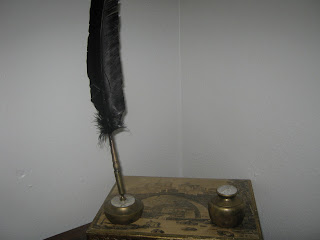
Yes, the quill pen does work. Is that why I bought it? Kind of. Come on you know it looks cool!
I hope you enjoyed the little look around my work space! I look forward to seeing your work area. Feel free to tell me about it in the comments. Also, exciting things coming to this blog! We will be having guest posts soon. Let me know if you are interested in participating.
Written by: Karoline Kingley
Do YOU Want to Write a Guest Post?
10 June 2013
I have a precious handful of followers who have been faithful commenters as well as bloggers. I've also noticed that a few of us have smallish audiences, and what blogger doesn't want more traffic their blog? I've been researching and apparently one of the ways to gain more followers is by writing guest posts. So, if any of y'all are interested in writing a guest post for my blog sometime, just let me know in the comments and I will get in touch with you! I would be more than glad to return the favor. Happy blogging!
Written by: Karoline Kingley
Written by: Karoline Kingley
Subscribe to:
Posts (Atom)
How to Hire a Literary Agent
Ok, so you have done everything you can in regards to your book/short story/memoir etc, and now the obvious next step is to publish...right?
Well dear friend, in case you haven't already noticed, becoming a traditionally published author is not as easy as it once was. Especially for amateurs. Turns out, the vast majority of publishers won't even consider reading your query (I'll get to that in a minute) much less a sample of your story unless you have an agent to represent you.
All this, I had heard before, since I've been cruising the internet, searching for publishing advice for a while now. Every blog, every article and every author testimony will tell you, "Hire an agent! Hire an agent! And oh, did I mention...HIRE AN AGENT!" Yeah, yeah--I get it. However, what these nincompoops seem resolved on NOT explaining, is exactly how one hires an agent. And after doing some extensive research over the past few days, I feel as though I may have observed enough to help out the writers who are as clueless as I once was.
Keeping in mind that I know next to nothing, and I tell you this assuming you know nothing, or next next to nothing. Get it? Got it? Good.
Step One: Research agents. Sounds simple enough. But before taking on this task there is something you should realize...to be a "literary agent", is not a real profession. Meaning, anyone can label themselves as an agent if they so choose. Therefore it is important to look into each agent's credentials. So whip out our best friend Google and start doing back ground checks on those bad boys. I HIGHLY recommend using various websites to help narrow down your search such as AgentTracker (just google it), or other handbooks like Publisher'sWeekly, LitearyMarketplace. Or 2013 Agent's Guide. If you desire, you can significantly narrow down your search by looking for local agents exclusively. Once again, GOOGLE IT. That's our new motto. When in doubt, inquire of the great Google!
Step Two: Write down every seemingly plausible representative for your book. Why? Because you're going to be sending out lots of queries. Why? Because you're going to get rejected sweet cheeks...sorry to bust your bubble.
Step Three: Go back and research those agents again, disregarding any who are not representing your genre, are not accepting queries right now, or any who look just plain shady and unreliable.
Step Four: Write a query letter, taking into account what each of those agents requests of you. I will write a new post soon talking about the query letter process.
Hopefully these tips have cleared away some of the confusion for you. Now, all you have to do is begin! I'm currently perfecting my query letter, and will update you on the process soon. If you have any tips regarding the obtaining of an agent, please share them in the comments below!
Written by: Karoline Kingley
MY First Lines
The first line of any book is the most important. If you are a writer, I'm sure this advice has been hammered into your head. Maybe you've had a good experience, and have yet to the know the tedious experience of re-writing a single sentence 100 + times until you are happy with it. That is the thing about writing. It will rarely (if ever) be perfect. You can only strive toward happy contentment in your own work.
There are obvious reasons why the opening line of a story is the most important. You want to make a good impression. Why would the audience continue reading the next chapter or even the next paragraph if you fail to hook them at first glance? And if you haven't already noticed, first lines are the most legendary. Few people will quote the 30th line from the 19th chapter in A Tale of Two Cities, but everyone remembers, "It was the best of times it was the worst times," etc...
But I'm here to tell you something contrary to popular belief. Sometimes, the first line does not have to sum up the entire story. I can tell you are already skeptical. But I caused myself a great deal of grief and writer's ache because I couldn't live up to that tried and true rule. Just to make things clear, it is, most of the time a good idea and even wonderful idea to write a first line that gives you one broad yet swift glance of the entire story, and then leave you hungering to know more. But not always.
Every now again, perhaps due to setting or style it is indeed acceptable to the throw the reader straight into an action scene. If the main idea is to hook the reader, can that not be just as adequately accomplished with a gripping glimpse into the dilemma at hand? You may have noticed this in my book Royal. I introduced the story by saying, "Jolenta's eyelids fluttered open at the sound of a faint creak." Is Jolenta the main character? No. Is the faint creaking a deeply metaphorical occurence? Not in the slightest. However, what is actually taking place, is very important, and is designed to make you interested to find out what will happen next.
But I also have experience with the opposite end of the spectrum. In my latest project for a romantic comedy the opening line is, "It has been nearly a decade since the last eligible bachelor worth mentioning came to Summerton." From that quick glimpse, you can probably tell where the story is going, which is exactly my intention.
The point is, it's okay to break the rules every now again. You don't have to send your readers off an emotional cliff with your first sentence. It's okay if I don't know what's going on, just as long as you make me interested to find that out myself. Go then my little writers, and be rebels!
Written by: Karoline Kingley
There are obvious reasons why the opening line of a story is the most important. You want to make a good impression. Why would the audience continue reading the next chapter or even the next paragraph if you fail to hook them at first glance? And if you haven't already noticed, first lines are the most legendary. Few people will quote the 30th line from the 19th chapter in A Tale of Two Cities, but everyone remembers, "It was the best of times it was the worst times," etc...
But I'm here to tell you something contrary to popular belief. Sometimes, the first line does not have to sum up the entire story. I can tell you are already skeptical. But I caused myself a great deal of grief and writer's ache because I couldn't live up to that tried and true rule. Just to make things clear, it is, most of the time a good idea and even wonderful idea to write a first line that gives you one broad yet swift glance of the entire story, and then leave you hungering to know more. But not always.
Every now again, perhaps due to setting or style it is indeed acceptable to the throw the reader straight into an action scene. If the main idea is to hook the reader, can that not be just as adequately accomplished with a gripping glimpse into the dilemma at hand? You may have noticed this in my book Royal. I introduced the story by saying, "Jolenta's eyelids fluttered open at the sound of a faint creak." Is Jolenta the main character? No. Is the faint creaking a deeply metaphorical occurence? Not in the slightest. However, what is actually taking place, is very important, and is designed to make you interested to find out what will happen next.
But I also have experience with the opposite end of the spectrum. In my latest project for a romantic comedy the opening line is, "It has been nearly a decade since the last eligible bachelor worth mentioning came to Summerton." From that quick glimpse, you can probably tell where the story is going, which is exactly my intention.
The point is, it's okay to break the rules every now again. You don't have to send your readers off an emotional cliff with your first sentence. It's okay if I don't know what's going on, just as long as you make me interested to find that out myself. Go then my little writers, and be rebels!
Written by: Karoline Kingley
My Writer's Workspace
Personally, I find that I can most productively channel my creativity when I'm in a creative atmosphere. Coffee shops and cubicles just don't really do it for me. I prefer to scribble away under the shade of an oak tree during fall or curled up by the fire with a cup of cocoa nearby. And while the best writers should be able to work in any place at any time...there is nothing wrong with humoring the romantic in you every now again. Thus, I have created a cute little workspace in my room that always makes me feel like a "real" writer. I keep objects and supplies close at hand that will fuel my inspiration, and hopefully eliminate any excuses to not write. So, without further aduei, let's have a look around.
This is presumably what I look like when writing.
And this is my desk! ...when it's clean...
I hope you enjoyed the little look around my work space! I look forward to seeing your work area. Feel free to tell me about it in the comments. Also, exciting things coming to this blog! We will be having guest posts soon. Let me know if you are interested in participating.
Written by: Karoline Kingley
This little guy sits on the corner of my desk. His name is Burp.
This is presumably what I look like when writing.
And this is my desk! ...when it's clean...
These pictures of London invigorate my wanderlust.
And I can always look over at my bookshelf. As any writer will agree, it's just nice to look at a stack of books.
Yes, the quill pen does work. Is that why I bought it? Kind of. Come on you know it looks cool!
I hope you enjoyed the little look around my work space! I look forward to seeing your work area. Feel free to tell me about it in the comments. Also, exciting things coming to this blog! We will be having guest posts soon. Let me know if you are interested in participating.
Written by: Karoline Kingley
Do YOU Want to Write a Guest Post?
I have a precious handful of followers who have been faithful commenters as well as bloggers. I've also noticed that a few of us have smallish audiences, and what blogger doesn't want more traffic their blog? I've been researching and apparently one of the ways to gain more followers is by writing guest posts. So, if any of y'all are interested in writing a guest post for my blog sometime, just let me know in the comments and I will get in touch with you! I would be more than glad to return the favor. Happy blogging!
Written by: Karoline Kingley
Written by: Karoline Kingley
Subscribe to:
Posts
(
Atom
)
